Transformation at the C Suite and Board Level: What Makes It Work?
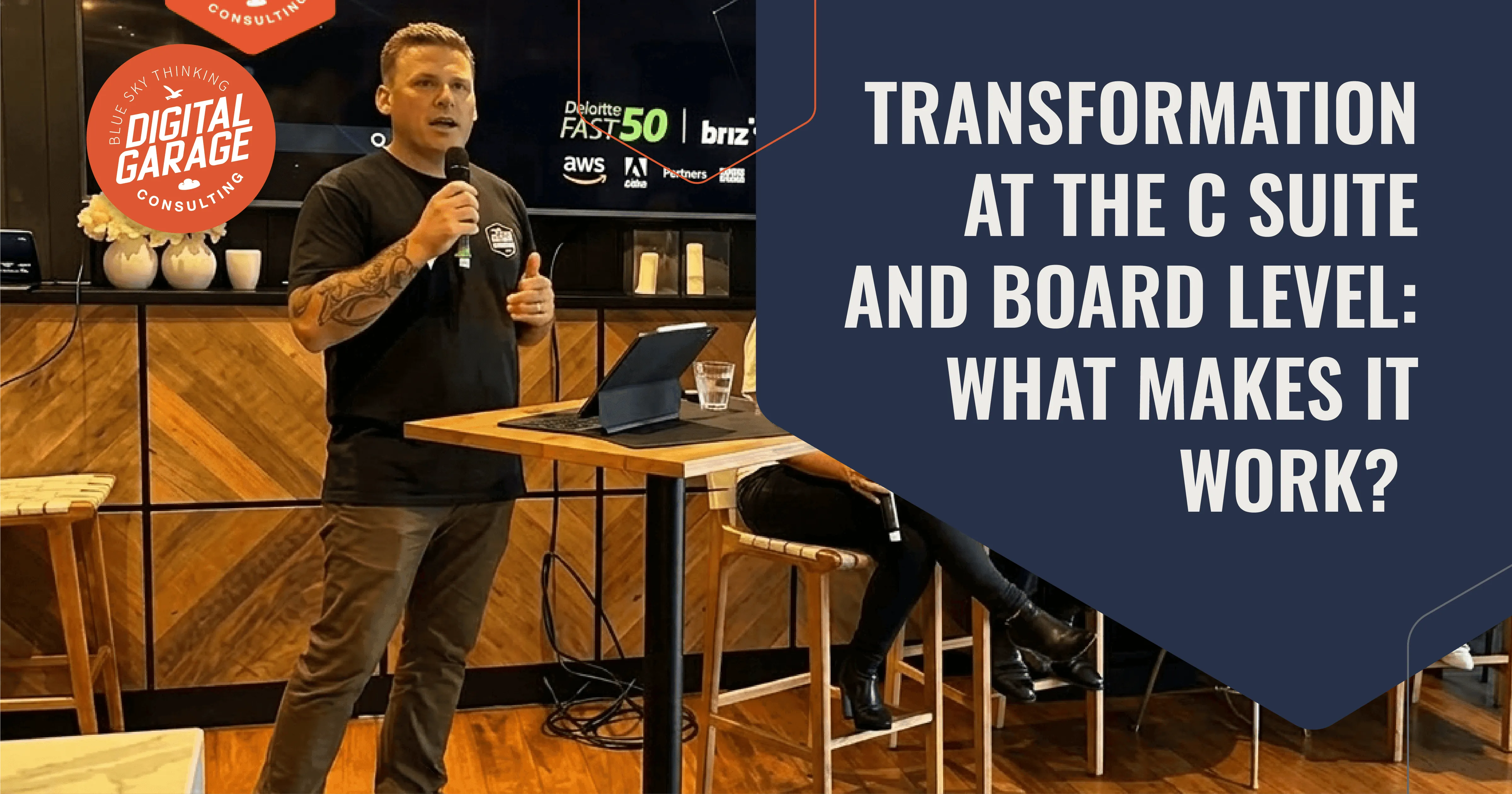
Across our recent Digital Garage series, we have explored transformation through different lenses. We examined strategy. We unpacked the role of data.
This final session focused on something just as critical. The people accountable for making transformation succeed at the highest level of an organisation.
At our Auckland breakfast, Jamie Blackwell was joined by Mark Daniels, Chief Transformation Officer at AA Insurance, Alex Smart, Chief Technology Officer at Southern Cross Travel Insurance, Ciara McGuigan, Chief Financial Officer at EROAD, and Lindsay Wright, Independent Director across Spark, NZX and Milford Asset Management.
The conversation centred on a practical question: what actually makes transformation work between the C Suite and the Board?
A number of consistent themes emerged as the discussion unfolded.
1. Renovating While Still Living in the House
Jamie opened with a practical analogy. Transformation, he said, is like renovating your house while still living in it. The plans may be drawn up and the structure reviewed, but the roof is partly off, the kitchen is in the garage, and daily life still has to continue.
The executive team are effectively the builders and architects, while the Board signs off on capital and carries accountability for long term value.
When those two groups are not aligned, progress slows and the renovation risks stalling altogether.
The analogy grounded the discussion in reality. Transformation is rarely a clean reset. It is complex, visible and often disruptive, and the business cannot simply pause while it happens.
2. Boards Evaluate Direction, Not Platforms
A consistent theme throughout the session was that Boards do not approve transformation because of technology alone.
Alex Smart noted that every Board brings a different perspective. Risk appetite, industry context and strategic priorities all shape how proposals are received. Executives who understand that lens are far better positioned to present change effectively.
When discussing foundational work such as modernising legacy systems, she reflected, "I don't think you would do a project just for that."
Technical debt may be obvious to delivery teams, but at the Board level, it becomes compelling only when translated into business consequences: speed to market, scalability, customer experience or strategic positioning.
From the director's perspective, Lindsay Wright added a clear reminder: "If we stand still, we're going backwards."
In fast-moving sectors, inaction carries its own risk. Transformation is not simply about improvement. It is about maintaining competitive relevance.
3. Articulating the Disbenefit
One of the more practical insights came from Mark Daniels when he spoke about defining trade-offs.
"It's about being able to articulate the disbenefit."
Boards are used to weighing options and expect clarity around risk. Executives often focus heavily on upside, outlining new capability, efficiency gains or improved experience. What strengthens credibility is being equally clear about what deteriorates if investment is delayed.
Lost opportunity, accumulating complexity and strategic constraint all compound over time.
When trade-offs are made explicit, transformation becomes more tangible. It moves beyond aspiration and becomes a structured decision grounded in consequence.
4. Executive Alignment Under the Microscope
Ciara McGuigan brought a CFO perspective to the discussion and spoke candidly about how boards assess leadership teams. "Boards want to see that the CFO and CTO are aligned. They'll be looking for tension."
Healthy challenge between finance and technology is expected. Lack of clarity is not.
When executive alignment is visible, board oversight becomes sharper and more constructive. When signals are mixed, scrutiny increases.
The panel also discussed the practical implications of commitment. In some organisations, boards are ensuring transformation leaders are properly resourced, including backfilling operational roles so senior capability can focus on change rather than juggling delivery and day jobs.
That decision signals seriousness. It demonstrates that transformation is not layered on top of business as usual. It is prioritised.
5. BAU Is Not a Safe Place
The conversation also moved beyond structure into mindset.
One speaker reflected on the early days of the internet in the 1990s and the boardroom conversations that took place then. Some organisations dismissed it. Others leaned in.
The lesson was clear. The businesses that survived were those with a curious and change-ready culture.
The panel acknowledged that there is no true long-term stability anymore. Transformation is not a one-off programme. It is an ongoing leadership discipline.
That reframes the board conversation. The question is not whether to transform. It is how deliberately and how cohesively to do it.
6. Culture as a Governance Issue
Culture emerged as a quiet but powerful theme. "You can track code and budgets," Jamie noted, "but you can't always track exhaustion."
Transformation creates sustained pressure. Without transparency, risks are hidden. Without trust, issues surface too late.
Ciara reflected on the difference between fear-based environments and learning-oriented ones, noting that the wrong culture can quietly undermine transformation progress.
Boards influence this indirectly through expectations, leadership appointments and tone. Executive teams influence it through behaviour and consistency.
Culture determines whether strategy translates into action.
What This Means for Leaders
As the session closed, Jamie connected this discussion back to the broader series. If the first event explored the how of transformation and the second examined the what, this final session addressed the who.
The takeaway was not technical. Transformation works when there is:
- Clarity of direction
- Honest articulation of trade-offs
- Visible executive alignment
- Board confidence in leadership cohesion
- A culture prepared for continuous change
Technology enables transformation. Alignment sustains it.
When the C Suite and the Board speak the same language about risk, value and accountability, change accelerates.
When they do not, even well-designed programmes struggle.
At Digital Garage, we believe these conversations matter. Because transformation is not simply about delivery. It is about the people responsible for steering it.
We'd love to connect!
When you need the best digital talent in NZ, whether for urgent temporary support or a long term strategic value, we have the expertise to help. Our depth of experience as digital recruitment specialists combined with a range of proactive and innovative sourcing solutions means that the people you want are already talking to us.